

Table of Contents
Direct Answer: Blue-collar staffing by trade means hiring pre-vetted welders, electricians, scaffolders, and steel fixers through a manpower supplier instead of recruiting each one yourself. In the UAE, this cuts deployment time from the usual 4–8 weeks of direct hiring down to about 1–2 weeks, keeps MOHRE and safety compliance off your plate, and lets you scale a crew up or down as the project moves.
⚡ Quick Facts
- Welders, electricians, scaffolders and steel fixers are the four most-requested trades on UAE construction and fit-out projects
- Manpower suppliers typically deploy a vetted worker within 1–2 weeks, versus 4–8 weeks for direct hiring — this piece focuses on what makes that worker the right one for each trade
- MOHRE requires trade-relevant certifications (e.g. welding test codes, scaffolding competency cards) to be on file before deployment
Most project delays don’t come from bad planning. They come from a scaffolder who never shows up, a welder whose certificate turns out to be expired, or an electrician who can’t actually read a UAE-standard single-line diagram. When you’re hiring trade by trade on a tight schedule, one bad placement can stall an entire site.
This is exactly why contractors, fit-out companies, and industrial operators across the UAE increasingly hire blue-collar workers through a dedicated manpower supplier rather than running four separate recruitment drives. Here’s what actually matters for each trade, and how to get it right.
If you’re still deciding between direct hiring and outsourcing, or need the visa, WPS, and MOHRE registration steps, our complete guide on how to hire blue-collar workers in the UAE covers that process end-to-end. This piece assumes you’ve made that call and picks up where trade-specific hiring decisions actually happen.
What Is Blue-Collar Staffing by Trade (and Why UAE Projects Need It)
Blue-collar staffing by trade is the practice of sourcing skilled manual workers based on the specific certification, tooling, and site experience their trade demands — instead of treating “labour” as one generic category.
A steel fixer and an electrician are both “site labour” on paper. In practice, they need completely different vetting: one is checked against structural drawings and rebar schedules, the other against UAE wiring regulations and low-current safety protocols. Generic recruitment often misses this, which is why so many project managers end up re-interviewing workers a supposedly vetted agency already placed.
A specialist manpower partner solves this by keeping trade-segmented talent pools — so when you need three scaffolders and one steel fixer by Thursday, they’re pulling from workers already tested for that exact trade, not generalists with a “can-do” attitude and no paperwork to prove it.
Welders for Hire in the UAE — What to Look For

Welding demand in the UAE spans oil & gas fabrication, structural steel, pipeline work, and marine projects — and each sector expects different qualifications.
Before accepting a welder, check for:
- Valid welding test certificates matching the process you need (MMA, TIG, MIG, or Flux-Cored) and the specific code (ASME, AWS, or EN standards depending on the client spec)
- Position qualification — a welder certified for flat welds isn’t automatically cleared for overhead or vertical work
- Recent site experience, not just certification age — a 3-year-old certificate with no recent hands-on work is a red flag on structural jobs
- NDT-pass history if the project requires radiographic or ultrasonic testing sign-off
A trade-specialist supplier pre-screens for all of this, so you’re choosing between candidates who already meet the spec — not discovering gaps after the first weld fails inspection.
Electricians in UAE Manpower Supply — Certifications That Matter
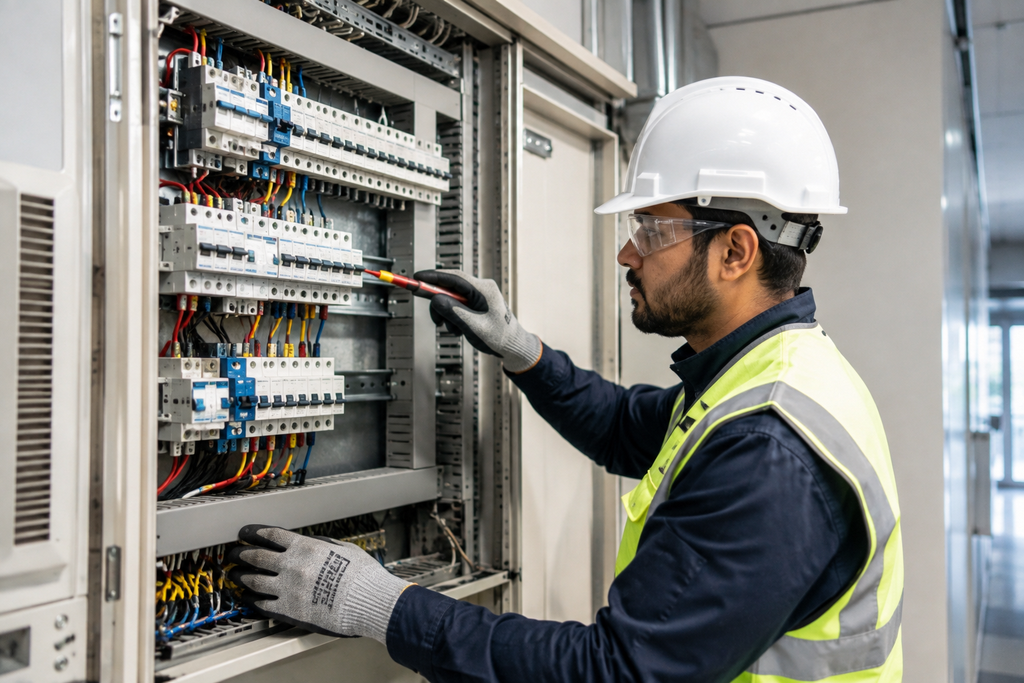
Electrical work in the UAE is tightly regulated, and DEWA, ADDC, and civil defence requirements vary by emirate and building type.
Look for electricians with:
- Recognised trade certification (City & Guilds, NVQ, or an equivalent recognised qualification)
- Experience with UAE-specific voltage standards and cable colour codes
- A documented safety record for live and low-voltage work
- Familiarity with the building type you’re working on — a villa fit-out electrician and a high-rise MEP electrician are not interchangeable
Because electrical mistakes carry real safety and liability risk, this is one trade where cutting corners on vetting almost always costs more later than the time saved hiring fast.
Scaffolders — Safety-First Hiring for High-Risk Trades

Scaffolding has the highest injury risk of the four trades covered here, which is exactly why UAE sites are strict about competency cards and supervised erection protocols.
Non-negotiables for scaffolder hiring:
- A valid scaffolding competency card (Basic, Advanced, or Supervisor level, matching the complexity of the structure)
- Documented training on the specific scaffold system used on-site (tube-and-fitting vs. system scaffold)
- A clean incident history — this is one area where a manpower supplier’s placement records genuinely protect you
- Physical fitness certification, since UAE heat and working-at-height rules both apply
If your current supplier can’t produce a competency card on request before deployment, that’s a compliance gap you don’t want to discover during a civil defence inspection.
Steel Fixers — Speed and Precision for Structural Projects

Steel fixing is where schedule pressure is highest — rebar has to go in before the pour date, and there’s no flexibility once concrete is booked.
What separates a reliable steel fixer from a risky hire:
- Ability to read structural drawings and bar bending schedules without supervision
- Experience with the tying method your structural engineer specifies
- Speed benchmarks appropriate to the project size (a supplier with placement history can tell you realistic output per crew, per day)
- Willingness and documented experience working within pour deadlines under supervision
Because steel fixing crews are often scaled up sharply just before a pour and scaled down right after, this is one of the clearest cases for on-demand labour solutions instead of permanent hiring.
How OnTime Sources and Deploys Trade Workers
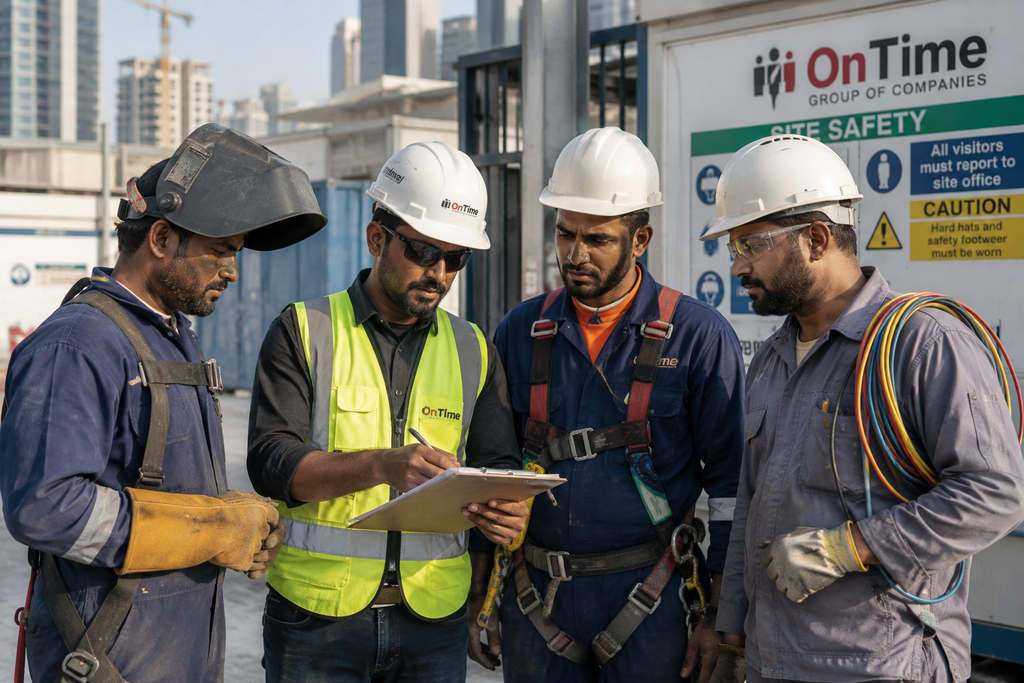
Step 1: Trade-specific brief We take your exact requirement — trade, certification level, number of workers, project duration — instead of a generic “labour needed” request.
Step 2: Pre-vetted talent pool matching Workers are pulled from certification-verified, trade-segmented pools, not sourced cold for each request.
Step 3: Compliance and documentation check MOHRE contracts, visa status, and trade certificates are verified before a worker is ever proposed to you.
Step 4: Deployment and site induction Workers are mobilised to site with induction support, so they’re productive from day one, not day five.
Step 5: Ongoing performance monitoring We track attendance, output, and safety incidents throughout the assignment, and swap out underperforming workers fast — something that’s far harder to do with a direct hire.
This is the same operating model behind our broader on-demand labour solutions, applied specifically to certified trades.
Visa processing and Emirates ID paperwork for every trade worker we deploy is handled through our PRO services team, so MOHRE documentation never becomes your bottleneck. And if a project needs full employer-of-record coverage for its trade crews — payroll, WPS, and end-of-service liability included — our EOR services can run alongside the manpower supply model rather than as a separate vendor.
Common Mistakes When Hiring Blue-Collar Workers by Trade
- Treating all “labourers” as interchangeable Why it’s bad: A generic labourer placed on a welding task without proper certification creates safety and inspection failures. Fix: Always hire against the specific trade certification, not a general labour category.
- Skipping certificate verification Why it’s bad: Expired or fraudulent certificates are more common than most project managers assume, especially with informal sourcing. Fix: Work with a supplier that verifies certificates before deployment, not after an incident.
- Hiring for peak demand only, then scrambling to scale down Why it’s bad: Permanent hires for short-term peaks leave you paying idle wages once the phase ends. Fix: Use flexible, trade-specific manpower supply for project-based spikes instead of permanent headcount.
- Ignoring Emiratisation and quota planning Why it’s bad: UAE workforce quotas affect how you structure hiring across trades and company size. Fix: Build quota awareness into your staffing plan — see our breakdown of Emiratisation meaning, key aspects and rules in the UAE.
- Not comparing the true cost of in-house recruitment Why it’s bad: Advertising, screening, visa processing, and onboarding time add up fast — often more than the supplier’s margin. Fix: Run the comparison honestly before deciding. See the breakdown below.
Blue-Collar Staffing by Trade vs Hiring In-House: Quick Comparison
| Factor | Hiring In-House | Trade-Specific Manpower Supply |
|---|---|---|
| Time to deploy | 4–8 weeks | 1–2 weeks |
| Certification verification | Your team’s responsibility | Pre-verified before proposal |
| Scaling up/down | Slow, contract-bound | Fast, project-based |
| Compliance (MOHRE, visas) | In-house admin burden | Handled by supplier |
| Cost during idle periods | Full wages continue | Pay only for active deployment |
| Replacement if underperforming | Lengthy termination process | Fast swap-out |
If your business is weighing this trade-off across every hire — not just blue-collar trades — our guide on how manpower outsourcing works and its key benefits breaks down the full picture.
Key Takeaways
- Welders, electricians, scaffolders, and steel fixers each need trade-specific vetting — not generic labour screening
- Certification verification before deployment prevents safety failures and inspection delays
- Trade-specific manpower supply deploys workers in days, not weeks, and scales with project phases
- Scaffolding and steel fixing carry the highest safety and schedule risk — vet these trades hardest
- Comparing true in-house hiring costs against supplier margins usually favours outsourcing for project-based work
Frequently Asked Questions
Q: How fast can I get certified welders or electricians deployed in the UAE?
A: Through a trade-specialist manpower supplier, deployment typically takes 1 to 2 weeks once certification and headcount requirements are confirmed, compared to 4–8 weeks for direct recruitment and visa processing. For the full visa, WPS, and legal process behind either route, see our complete guide on how to hire blue-collar workers in the UAE.
Q: Do manpower suppliers verify trade certificates before deployment?
A: A reliable supplier verifies welding codes, scaffolding competency cards, and electrical qualifications before proposing a worker — not after they’re already on-site, which is where most compliance risk hides.
Q: Can I hire steel fixers for a short-term project only?
A: Yes. Trade-specific manpower supply is built for project-based demand, so you can scale steel fixing crews up before a pour and down immediately after, without carrying permanent headcount costs.
Q: What’s the difference between hiring a scaffolder directly and through a supplier?
A: A supplier maintains verified competency cards and incident histories across their scaffolder pool, which reduces the safety and liability risk that comes with informally sourced labour.
Q: Does trade-specific staffing help with Emiratisation quota compliance?
A: A manpower partner familiar with UAE quota rules can help structure your blue-collar and skilled workforce mix so you stay compliant without over- or under-hiring UAE nationals in roles that don’t need them.
If your project also needs office-based hires or leadership roles filled alongside your trade crews, our executive staffing solutions and recruitment process outsourcing services cover that side of the workforce, while PEO services can handle payroll and HR compliance across your whole company, not just the trade workforce.
Conclusion
Blue-collar hiring in the UAE isn’t about finding “workers.” It’s about matching the right certified welder, electrician, scaffolder, or steel fixer to a specific project need, fast enough that your schedule doesn’t slip. Generic labour hiring almost always costs more in delays, rework, and compliance risk than it saves in supplier fees.
Need Certified Trade Workers on Site — Fast?
OnTime supplies pre-vetted welders, electricians, scaffolders, and steel fixers across the UAE, with MOHRE compliance and certification checks handled before deployment.
Request Trade Workers Now →Explore On-Demand Labour Solutions • The OnTime Edge