
Table of Contents
Hiring in Dubai sounds straightforward — until you look at what it actually takes. MOHRE registration. WPS payroll compliance. Visa sponsorship. End-of-service gratuity calculations. And that’s before you’ve even thought about whether you need a legal entity.
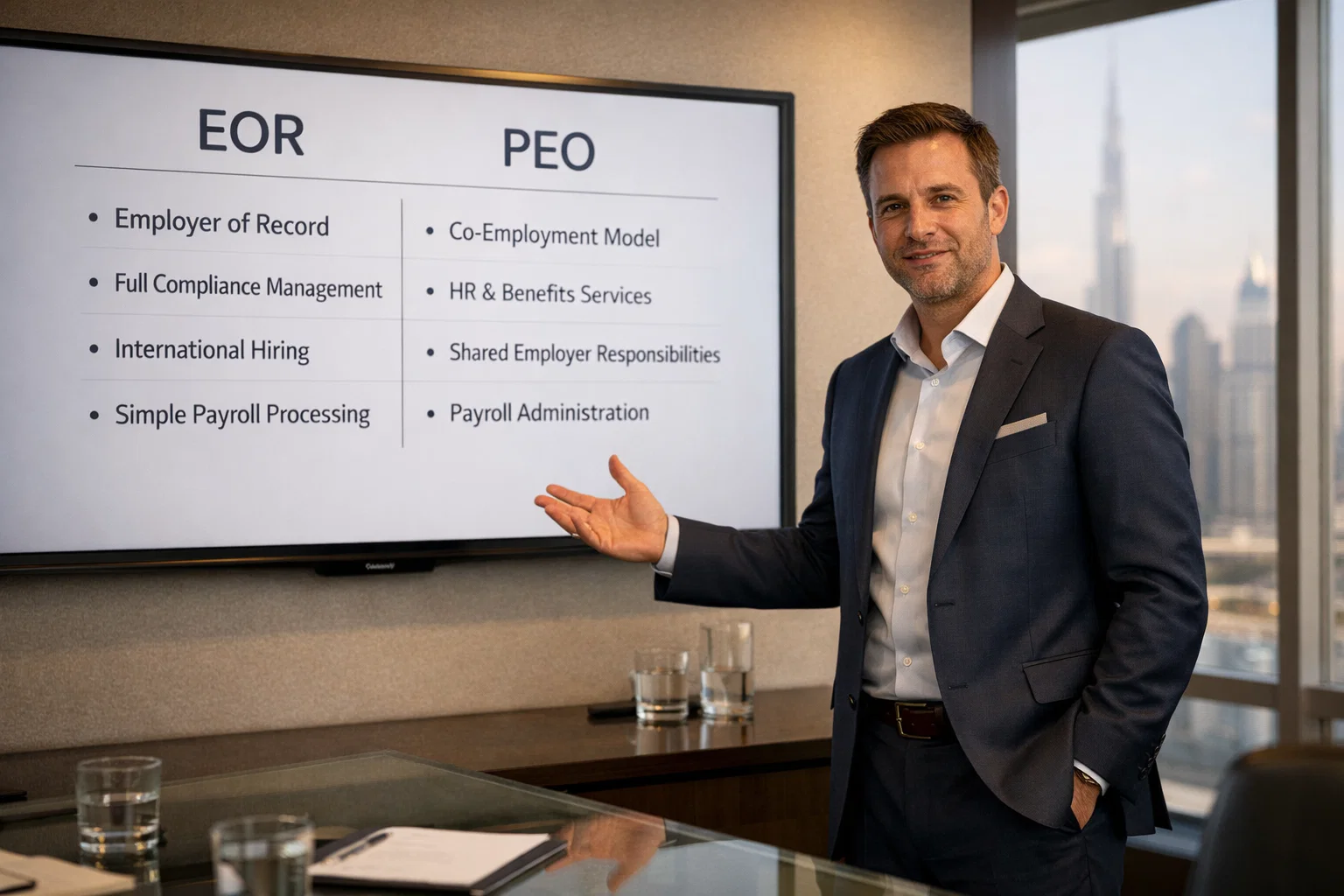
For businesses entering the UAE or trying to scale without adding HR overhead, two services come up repeatedly: PEO (Professional Employer Organization) and EOR (Employer of Record). They sound similar. They’re often confused. But they solve very different problems — and picking the wrong one can slow you down or create compliance gaps.
This guide breaks both down clearly so you can make the right call.
Quick Facts
- An EOR legally employs your workers in the UAE — you don’t need your own entity
- A PEO co-employs staff but requires your business to already have a registered UAE entity
- EOR is typically faster to activate and better suited for market entry or project-based hiring
- PEO works best for established businesses looking to outsource HR administration
- Both operate under UAE Federal Decree-Law No. 33 of 2021 and must comply with MOHRE regulations
What Are PEO and EOR Services?

Both PEO and EOR are workforce management services that help businesses hire and manage employees in the UAE without building a full in-house HR function. Same goal, very different setup.
PEO — Professional Employer Organization A PEO is a third-party provider that co-manages your workforce alongside your business. Think of it as outsourcing your HR department. The PEO takes over payroll processing, employee benefits, compliance filings, and HR administration — while you retain full control of who you hire and how they work. Your business remains the primary employer. The PEO simply handles the back-office burden that comes with it.
To use a PEO in the UAE, your business must already have a registered legal entity — a trade licence, a MOHRE account, and the ability to sponsor employees.
EOR — Employer of Record An EOR takes a different approach entirely. Instead of working alongside your entity, the EOR becomes the legal employer of your workers — on paper and in practice. Your staff are contracted, registered, and payrolled under the EOR’s own UAE trade licence. You have no entity requirement and no direct employer obligations. You simply manage the day-to-day work while the EOR handles everything else.
This makes EOR particularly valuable for businesses entering the UAE for the first time, running short-term projects, or testing a market before committing to a full local setup.
Both services are governed by UAE Federal Decree-Law No. 33 of 2021 and must comply with MOHRE regulations and the Wage Protection System (WPS).
What is the difference between a professional employer organization (PEO) and an employer of record (EOR)?
A Professional Employer Organization (PEO) enters a co-employment arrangement with your business. You keep day-to-day control of your team, while the PEO manages the HR side — payroll, benefits, compliance filings. The catch: your business must already have a legal entity in the UAE.
An Employer of Record (EOR) goes further. The EOR becomes the legal employer of your workers on paper. They handle employment contracts, MOHRE registration, WPS-compliant payroll, and end-of-service gratuity — all under their own UAE trade licence. You don’t need a local entity to get started.
The simplest way to frame it:
| Feature | PEO | EOR |
|---|---|---|
| UAE legal entity required | Yes | No |
| Who is the legal employer | Shared (co-employment) | EOR is the employer |
| WPS payroll compliance | Yes | Yes |
| MOHRE registration | Shared responsibility | Fully handled by EOR |
| Visa sponsorship | Through your entity | Through EOR’s entity |
| Best suited for | Established businesses | Market entry or short-term hiring |
How EOR companies and PEOs help businesses?
Both models reduce administrative burden — but the mechanism is different.
How an EOR works:
- Sponsors your employees under its own UAE trade licence
- Registers them with MOHRE and processes WPS-compliant payroll
- Manages visas, Emirates ID, and employment contracts
- Calculates and accrues end-of-service gratuity correctly
- You focus on directing the work — the EOR handles everything else
How a PEO works:
- Partners with your existing UAE entity in a co-employment structure
- Takes over payroll processing and HR administration
- Manages employee benefits, government filings, and compliance
- Reduces your internal HR workload without changing who legally employs the staff
A real-world scenario: A UK-based logistics firm wants to place three project managers in Dubai for a six-month contract. They don’t have a UAE entity. They use an EOR — workers are contracted, compliant, and operational without any entity setup. Once the project converts to a permanent operation and they register locally, they transition to a PEO to manage ongoing HR without building an internal team.
Related reading: How to Hire Employees in Dubai Without Setting Up a Company
Why should you use an Employer of Record (EOR)?

If you’re entering Dubai for the first time — or need to hire fast without the overhead of entity setup — an EOR is almost always the lower-friction path.
1. No legal entity required Setting up a UAE company involves trade licence registration, office lease, bank accounts, and regulatory approvals. An EOR removes all of that from the critical path.
2. Full UAE labour law compliance from day one EOR providers ensure workers are covered under Federal Decree-Law No. 33 of 2021, registered with MOHRE, WPS-enrolled, and entitled to their correct end-of-service gratuity.
3. Lower financial risk on market entry You cover workforce costs without committing to permanent infrastructure. If the project ends or the market doesn’t convert, your exposure is contained.
4. Faster to activate No entity waiting period. Your team can be onboarded as soon as contracts and documentation are in order.
5. Built-in Emiratisation awareness EOR providers operating in the UAE understand the Emiratisation rules and obligations that apply to businesses employing workers in the private sector. That’s one less compliance area for you to manage alone.
For a full breakdown, read: The Complete Guide to Employer of Record in the UAE
Why should you use Professional Employer Organization (PEO)?

If you’re already operating in the UAE with a registered entity, a PEO can significantly reduce your internal HR load — without losing control of your team.
Where PEO adds value:
- Consolidated payroll processing across your entire workforce
- Managed employee benefits administration (health, leave, allowances)
- Reduced risk of HR compliance errors and MOHRE filing gaps
- Structured onboarding and offboarding processes
- Access to more competitive benefits packages through the PEO’s pooled structure
A PEO works best when you want to retain full operational control of your team but hand off the administrative complexity — particularly as headcount grows and the HR burden becomes unsustainable in-house.
Related reading: Benefits of Using a PEO in Dubai
PEO vs EOR: Which Model Fits Your Situation?
Use this as a quick decision guide:
Choose EOR if:
- You don’t have a UAE legal entity yet
- You’re testing a new market before committing
- You need to hire 1–15 employees quickly
- Your engagement is project-based or time-limited
- You want minimum administrative setup
Choose PEO if:
- Your business already has a UAE entity
- You have a growing team and HR is becoming a bottleneck
- You need consolidated benefits and payroll management
- You want to scale headcount without expanding your HR department
How to choose the right employer of record (EOR)
Not all EOR providers operate at the same standard. Before signing anything, ask:
- Are they MOHRE-compliant? Any EOR operating in the UAE must work within Ministry of Human Resources and Emiratisation regulations.
- Do they handle WPS payroll directly? This is a legal requirement — not optional.
- How do they manage end-of-service gratuity? Miscalculations create direct legal liability.
- What does their onboarding process look like? Delays at this stage defeat the purpose.
- Do they have experience in your sector? An EOR managing construction labour has very different requirements to one handling corporate or white-collar hires.
Explore OnTime UAE’s EOR services in Dubai and PEO services to understand what’s included.
Which is the better choice when hiring internationally?
For international businesses entering the UAE, EOR is almost always the starting point. It removes the largest barrier to market entry — the need for a local legal entity — and compresses the time between decision and deployment.
Once you’re established, headcount justifies a permanent HR function, and you’ve registered locally, a PEO or hybrid model becomes a natural evolution.
Both can also coexist. Larger organisations sometimes use an EOR for short-term or contract hires and a PEO structure for their permanent local workforce. The two aren’t mutually exclusive — they serve different workforce categories.
Frequently Asked Questions
Q: Can I switch from EOR to PEO later?
Yes. Many businesses start with an EOR to enter the market quickly, then transition to a PEO once they’ve established a UAE entity and want to manage HR through a co-employment model.
Q: Does an EOR work across all industries in Dubai?
EOR services are broadly applicable, but some sectors — such as construction and hospitality — carry sector-specific licensing and labour category requirements. Confirm the scope with your provider upfront.
Q: Is a PEO the same as a staffing or recruitment agency?
No. A PEO co-employs your workforce and manages HR administration. A staffing agency recruits and places workers. The employment relationship and the scope of service are different.
Q: What UAE laws apply to EOR and PEO arrangements?
Both models operate under Federal Decree-Law No. 33 of 2021, MOHRE regulations, and the Wage Protection System (WPS) framework. End-of-service gratuity obligations also apply.
Q: Do I still control how my employees work under an EOR?
Yes. The EOR is the legal employer on paper and manages compliance. You direct the actual work — tasks, performance, targets, and day-to-day management remain entirely with you.
Ready to hire in Dubai the right way?
OnTime UAE offers both EOR and PEO services — fully compliant with UAE labour law and built for businesses that can’t afford compliance gaps.
Explore EOR Services → Explore PEO Services → Talk to Our Team →