

The biggest hiring challenges in Dubai are UAE labour law compliance, Emiratisation quotas, talent competition, high employee turnover, slow hiring timelines, and the difficulty of hiring without a registered UAE entity. Most stem from limited in-house HR expertise — and nearly all can be resolved through outsourcing models like EOR, PEO, or managed manpower solutions.
Quick Facts — Hiring in Dubai
- Federal Decree-Law No. 33 of 2021 governs all private sector employment contracts in the UAE
- Private companies with 50 or more employees must meet mandatory Emiratisation targets
- In-house hiring in Dubai typically takes 4 to 8 weeks end-to-end
- Replacing one employee can cost between 50% and 200% of their annual salary
- Foreign companies can hire legally in the UAE without setting up a local entity — through an Employer of Record
Why Hiring in Dubai Is Harder Than It Looks

You need to hire in Dubai. You post the job, shortlist a few decent candidates — and then things stall. A compliance document you’re not sure about. A visa timeline you didn’t plan for. A strong candidate who accepted another offer while your internal approvals were still going around in circles.
Here’s the uncomfortable truth: most businesses in Dubai are quietly losing time, money, and good people to hiring friction they didn’t see coming.
UAE labour law — significantly overhauled in 2021 — catches companies off guard with contract requirements, WPS obligations, and gratuity calculations that are easy to get wrong. Emiratisation targets are tightening every year, with real financial penalties for businesses that miss them. And in a city where multinationals, free zone startups, and regional enterprises are all chasing the same mid-to-senior talent pool, a slow hiring process doesn’t just cost you a candidate — it costs you momentum.
The team that was supposed to be fully operational six months ago is still one hire short. That gap gets filled with overtime, workarounds, and the quiet frustration of good people covering for a problem that’s been there too long.
Every one of these challenges is solvable. Not with a workaround — with the right approach. This guide breaks down the six most common hiring challenges businesses face in Dubai, and exactly how companies are fixing them right now.
Challenge 1 — Navigating UAE Labour Law and Compliance
UAE labour law isn’t difficult to understand once you know it. The problem is most businesses find out what they don’t know after something goes wrong.
Federal Decree-Law No. 33 of 2021 overhauled the private sector employment framework significantly. It introduced new contract types, updated end-of-service gratuity rules, and added stronger protections around termination and leave. Layered on top of that is the Wage Protection System (WPS) — enforced by MOHRE — which requires all salaries to be processed through approved financial channels and reported on a strict monthly schedule.
Miss a WPS deadline and MOHRE can freeze your company’s hiring permissions. Use an outdated contract template and you’re exposed if the employee files a complaint. Miscalculate end-of-service gratuity on a limited versus unlimited contract and you’re carrying a financial liability you don’t know about yet.
Common compliance mistakes companies make:
- Using contract templates that predate the 2021 legal reforms
- Missing WPS salary cycles due to manual or unstructured payroll processes
- Incorrect gratuity calculations — especially during contract transitions
- Poor termination documentation that creates dispute risk
What actually works:
An Employer of Record in the UAE takes on legal employer responsibility — contracts, payroll, WPS reporting, and gratuity calculations are handled correctly from day one. You stay in operational control of your people. The compliance risk and legal obligation sit with the EOR, not you.
Challenge 2 — Meeting Emiratisation Quotas

Emiratisation is no longer a soft government preference. It’s a legal obligation — with financial penalties for private sector companies that miss their annual targets.
OnTime UAE works with businesses across industries navigating exactly this challenge. The core difficulty isn’t awareness — most HR teams know the requirement exists. The difficulty is execution. Recruiting UAE nationals into sectors they haven’t historically entered at scale, at salaries that work within budget, and retaining them beyond an initial contract period, is genuinely hard.
Private companies with 50 or more employees face mandatory Emiratisation targets, reviewed and updated annually. Miss your quota and your company pays a monthly contribution to the National Programme for Emiratisation. That’s a recurring, predictable cost — and it compounds.
What’s actually working for businesses right now:
- Building structured Emirati development and progression pathways — not just filling headcount slots to hit a number
- Partnering with providers who maintain active UAE national candidate databases, rather than starting cold with every vacancy
- Understanding which specific roles count toward your Emiratisation calculation — not every position qualifies, and many companies get this wrong
For a complete breakdown of how the requirements apply to your business size and sector, the guide on Emiratisation in the UAE covers the rules clearly.
Challenge 3 — Finding the Right Talent in a Competitive Market
Dubai doesn’t have a talent shortage in the traditional sense. The people are here. The problem is every company wants the same ones.
You’re competing with multinationals, free zone businesses, and well-funded startups — all recruiting from the same mid-to-senior talent pool in technology, logistics, finance, healthcare, and professional services. Bayt, LinkedIn, and GulfTalent are crowded. Strong candidates receive multiple simultaneous approaches. If your process takes three weeks to reach a second interview, they’re already onboarded somewhere else.
Where companies lose candidates:
- Job descriptions that are too generic — attracting applications by volume rather than quality
- Multi-layer internal approval chains that slow offer decisions past the candidate’s patience threshold
- Single-channel sourcing with no backup pipeline when a role goes cold
What fast-moving companies do differently:
- Write job briefs that filter candidates, not just attract them — specificity saves time at every stage
- Target a first-to-offer timeline of under two weeks for competitive or senior roles
- Use a Recruitment Process Outsourcing partner with pre-qualified pipelines — so you’re not starting from zero every time a position opens
Challenge 4 — High Employee Turnover

Dubai runs on a transient, expatriate-heavy workforce. People arrive for a contract cycle, move for a better package, or return home. That’s the nature of the market — and it creates turnover rates that are among the highest of any major commercial city.
Replacing one employee — when you account for sourcing, onboarding time, and the productivity gap during the transition — typically costs between 50% and 200% of that person’s annual salary. For an SME with a lean team, losing three people in a year doesn’t just slow you down. It compounds. You’re perpetually behind.
Root causes that are worth addressing directly:
- Expectation gaps created at the hiring stage — vague role scope, unclear progression, salary that’s competitive at start but stagnates
- No structured onboarding programme — new hires who don’t feel settled in the first 90 days leave faster
- Workforce management handled reactively rather than proactively
Real scenario:
A mid-size logistics company in Dubai was replacing approximately 30% of their blue-collar workforce every year. After moving to a managed manpower outsourcing model, their provider handled ongoing workforce management, replacements, compliance, and labour supply continuity. Headcount stabilised. The internal operations team stopped spending half their time on hiring admin.
To understand how labour supply companies help UAE businesses scale faster without the turnover burden, that guide walks through the model in detail.
Challenge 5 — Slow and Costly Hiring Processes
Every day a critical role sits vacant costs real money. Lost output. Overtime for existing staff. Delayed client delivery. Most companies know this — but significantly underestimate how much of that delay they’re generating themselves.
In-house HR teams in the UAE are stretched. When an urgent hiring need appears, they often don’t have the infrastructure to move fast. They source from scratch. They wait on internal approvals. They navigate visa paperwork they don’t process regularly enough to know cold. And onboarding gets improvised because nobody owns it properly.
Where the typical bottlenecks sit:
| Stage | Common Delay |
|---|---|
| Sourcing | No pre-qualified pool — starting cold every time |
| Approvals | Slow internal sign-off chains on hiring decisions |
| Visa and immigration | Documentation errors, unfamiliar processes |
| Onboarding | No structured programme — new hires left to find their feet |
How to fix it:
For short-term, project-based, or surge demand situations, on-demand labour solutions let businesses deploy workers quickly — without running a full recruitment cycle for every hire. Time-to-productivity drops significantly.
For permanent or longer-term roles, a structured Recruitment Process Outsourcing arrangement puts a specialist team on your sourcing and screening — so your internal team stays focused on operations rather than hiring admin.
Challenge 6 — Hiring Without a Legal Entity in the UAE
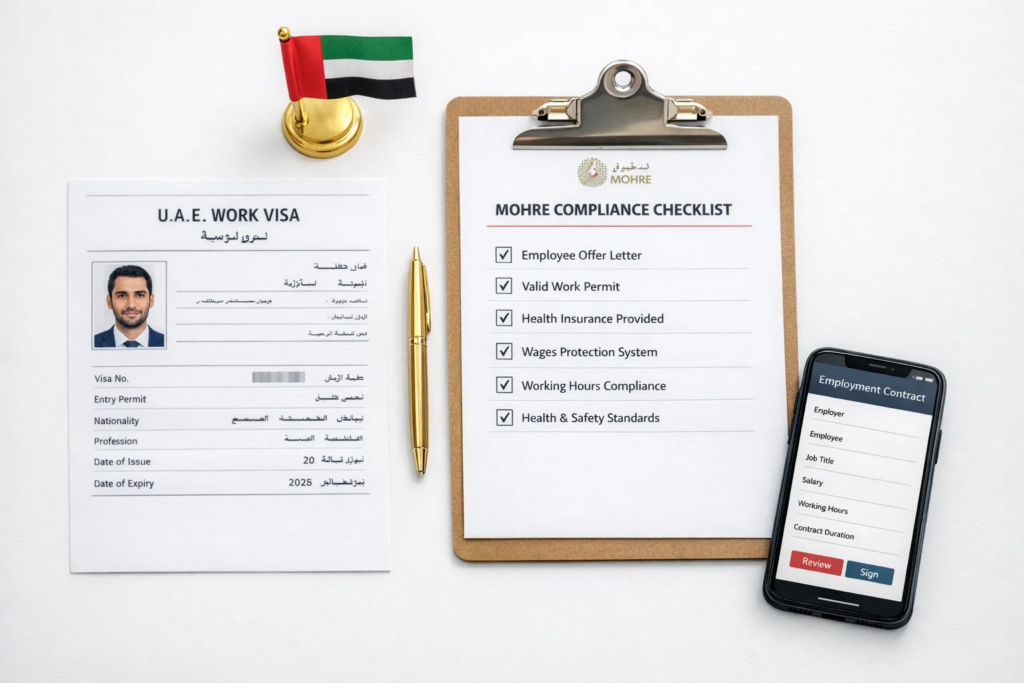
This challenge catches international businesses off guard more consistently than almost any other.
You want to hire one or two people in Dubai — a sales lead, a regional manager, a small team to test the market. But you don’t have a registered UAE entity. Setting one up takes months, carries significant upfront cost, and brings ongoing maintenance obligations you’re not ready for.
Without a legal entity, you cannot issue UAE employment contracts, register employees with MOHRE, or sponsor work visas. Contractor arrangements — the common workaround — carry misclassification risk that creates larger problems down the line.
The model built specifically for this situation:
An Employer of Record. The EOR becomes the legal employer in the UAE on paper. Your workers are employed under the EOR’s entity — with fully compliant UAE contracts, MOHRE registration, visa sponsorship, and WPS payroll. You manage and direct the people day-to-day. Every legal and administrative obligation sits with the EOR. You go from decision to operational in days, not months.
The complete guide to Employer of Record in the UAE explains the model in full. If you’re also weighing your broader options, how to hire employees in Dubai without setting up a company walks through every available route.
How Outsourcing Solves Most of These Problems
Look across all six challenges and a pattern becomes obvious. Compliance complexity. Emiratisation obligations. Talent competition. High turnover. Legal entity barriers. At their core, they’re all resource and knowledge problems. Businesses without deep UAE HR expertise in-house carry every one of those risks themselves.
Outsourcing the right parts of your hiring and workforce management to a specialist like OnTime UAE changes that equation. You get the expertise without building the team. You get compliance coverage without absorbing the liability. You get hiring speed without the infrastructure investment.
Here’s how the models map directly to each challenge:
| Challenge | Best-Fit Solution |
|---|---|
| UAE labour law compliance | Employer of Record Services |
| Emiratisation targets | PEO Services + Emiratisation support |
| Talent sourcing and speed | Recruitment Process Outsourcing |
| High turnover and workforce continuity | Manpower Outsourcing |
| Surge demand and short-term needs | On-Demand Labour Solutions |
| Hiring without a UAE legal entity | Employer of Record UAE |
Not every business needs every solution. The starting point is being honest about where your specific friction is — and choosing the model that fits it. Not sure which direction makes sense? The guide on how to choose the right manpower company in the UAE gives you the right questions to ask before you commit.
Frequently Asked Questions
Q: What are the most common hiring mistakes companies make in Dubai?
The most common mistakes are using non-compliant contract templates, missing WPS salary deadlines, underestimating Emiratisation obligations, and starting recruitment too late for urgent roles. Most stem from not having UAE-specific HR knowledge in-house — which is why many businesses outsource these functions to a specialist.
Q: How long does it take to hire someone in Dubai?
End-to-end in-house hiring typically takes four to eight weeks — from job posting through to onboarding. With an EOR or RPO partner who has pre-qualified pipelines, that timeline can compress significantly, especially for roles that need to be filled urgently.
Q: Can a foreign company hire employees in Dubai without registering a company?
Yes. Through an Employer of Record, a foreign business can hire UAE-based employees legally without a local entity. The EOR acts as the legal employer and manages all employment obligations on your behalf. The full guide to hiring in Dubai without a company explains how it works.
Q: What is Emiratisation and does it apply to my business?
Emiratisation is the UAE government's requirement for private sector businesses to employ UAE nationals at set annual ratios. It currently applies to companies with 50 or more employees in most private sectors. Missing your quota means paying a monthly financial contribution. A full breakdown is available in the Emiratisation guide.
Q: What is the difference between an EOR and a PEO in the UAE?
An EOR becomes the legal employer of your workers and takes on full employment liability — making it ideal for companies without a UAE entity. A PEO co-employs workers alongside your business and typically requires some local presence. For companies entering the UAE for the first time, EOR is usually the right starting point. Compare both models here.
Conclusion
Hiring in Dubai doesn’t have to be this complicated. But it is — unless you either build serious in-house UAE HR expertise, or partner with someone who already has it.
The six challenges in this guide are not edge cases. They’re the standard experience for most businesses trying to hire and grow in the UAE without dedicated specialist support. And every one of them has a clear solution — whether that’s an EOR for compliance and entity issues, RPO for talent sourcing, PEO for Emiratisation, or on-demand labour for surge needs.
The question isn’t whether these challenges apply to you. It’s whether you’re handling them in the most efficient way possible — or absorbing costs and risk you don’t need to carry.
Ready to simplify hiring in Dubai?
Whether you need one person onboarded compliantly or an entire workforce managed end-to-end, OnTime UAE can help.